

Prokletije National Park
The Prokletije National Park is the youngest of the Montenegrin national parks, having been established only in 2009. It is located in the border area between Montenegro and Albania and Kosovo in the extreme south of the Dinaric mountain range. The neighboring municipalities of Plav and Gusinje form the best access points to the 16,630-hectare park.
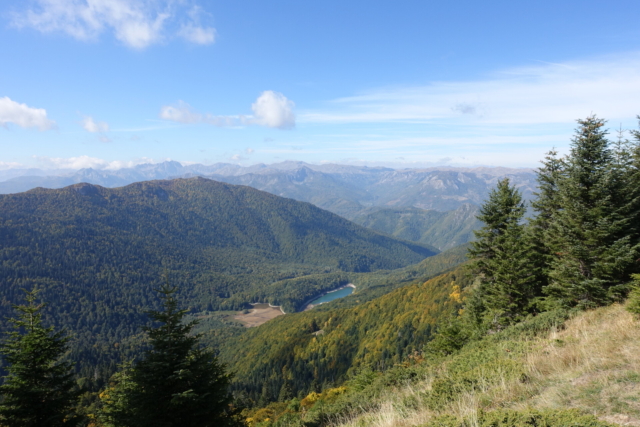
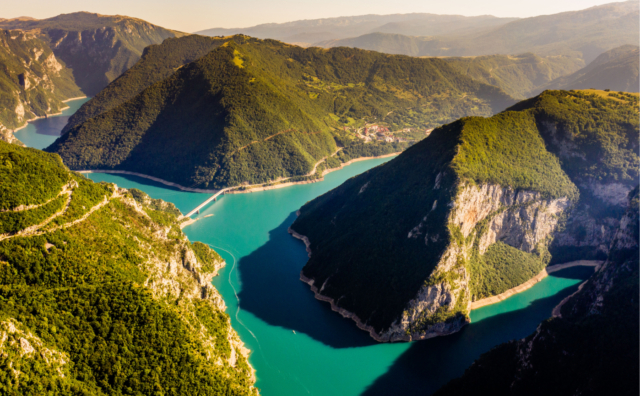
The landscape of the National Park is wild and rugged, with deep gorges, steep mountain slopes, deep-cut river valleys and mountain peaks over 2,500 m high.

The park has many larger and smaller watercourses, stratified and karst springs with fresh and also with highly mineralized spring water, foaming streams and crystal-clear glacial lakes. The most famous of the glacial lakes is Hridsko Lake, which is also considered the most beautiful lake in the park.

The remoteness of the park and the sparse population density of the region have preserved this jewel of high-mountain biodiversity to this day. In the park, one finds various forest ecosystems with deciduous and coniferous trees, as well as typical mountain and alpine forests with enclosed meadows that are partly grazed from the katuns.
Those who find the Durmitor National Park “overcrowded” during the high season will love it here.
Particular highlights in the park are Lake Hridsko and the Volusnica mountain peak on the edge of the Grebaje valley – both the destination of rewarding hikes.
Nature
Flora
The Montenegrin part of Prokletije shows many characteristics of the Central European flora, interspersed with a significant proportion of Arctic-Alpine to sub-Mediterranean elements. Many plant species are endemic, relics or at least very rare. Of importance to the mountain farmers are the many medicinal plants found on the mountain pastures.


Although the park area has not yet been fully explored or mapped in terms of plant geography, over 1,700 plant species are already known in the park, which corresponds to approximately half of all Montenegrin plant species, or about 1/5 of the entire Balkan flora.
The inaccessibility of the terrain is the main reason why some species have survived and were only recently discovered.

Fauna
About 60 endemic insect species and about 130 butterfly species have already been found in the park. It is also considered an important centre of herpetofauna (amphibians and reptiles). Forty species of amphibians and reptiles have so far been recorded in the wider Prokletije area; nine of them are endemic, meaning they occur only here. In the far south-eastern part of the Prokletije massif, the Alpine salamander (Salamandra atra) has been discovered, which is protected nationally and internationally. The rare species of the viviparous wood lizard (Lacerta vivipara) can be found in the area around Hridsko Lake.
The fish fauna consists of native species such as brown trout, European bullhead, grayling, huchen, chub, lamprey, etc.

In the Prokletje National Park, 161 bird species were recorded. Their habitats are the mountain regions, the valleys of Ropojane and Grebaje, the various forest ecosystems, as well as the mountain lakes and streams. The most important bird species include the grey heron, Eurasian spoonbill, Eurasian teal, bearded vulture, griffon vulture, short-toed snake eagle, northern goshawk, common buzzard, Eurasian sparrowhawk, golden eagle, hazel grouse, crossbill, etc.
There are numerous species of bats and rodents in the park, as well as a considerable number of mammals such as the wolf, the impressive brown bear, the wildcat, wild boar, chamois, roe deer and rabbits.
Culture
Even despite its remoteness, the Prokletije National Park also has a rich cultural and historical heritage. Proof of this are the numerous historical buildings, mosques, relics of traditional folk architecture, as well as characteristic costumes, folk music and dances, folklore, customs and traditional crafts that have developed within and especially around the park in the villages and small communities and have been preserved to this day.
Important witnesses of the prehistoric period are the “Game Hunt” drawings from the seventh century BC that can be seen carved in the rocks on the hill Vezirova brada/Vizier in the Grebaje valley. Next to them is an engraved stone plate in Volušnica called “The Great Mother“ that depicts a scene in which a man and a woman fight a wolf that is about to attack their child. It dates back to the Middle Bronze Age (ca. 600 BC).
Remains of settlements date back to the Palaeolithic, Copper and Bronze Ages, the Illyrian period and the Roman Empire. Remains of sacred buildings and fortifications date back to the Middle Ages, and numerous monuments with oriental features date back to the time of the Ottoman rule.
Located a little outside the park but nevertheless very worth seeing because of its great architectural, artistic and historical value, are the Old Mosque from the 15th century, the tower of Redžepagić, a church dedicated to the Holy Trinity from the twelfth century, the Wesir Mosque from the eighteenth century, the Balić Tower and the Church of St. George.
Traditional life in the Prokletije region also includes the katuns (mountain pastures). They usually consist of several huts, so-called “dwellings”, built of wood and stone, and stables for the livestock.
Tourism
Visitor Centre
The Visitor Center of the Prokletije National Park is located in Gusinje, on the way to the beautiful Alipaa/Alipasini springs and the Ropojana Valley. In the information centre, visitors will find everything they need for an enjoyable visit to the park, as well as information on the flora and fauna, culture, and activities available in the park – especially the hiking trails. The Prokletje National Park is crossed by the now famous “Peaks of the Balkans” long-distance hiking trail, so you will often encounter hikers with large backpacks.
The visitor centre also has a souvenir shop with a selection of locally handmade products.
The opening hours are:
- During the summer season on weekdays: 9:00 – 17:00 h
- Outside the summer season on weekdays: 8:00 – 16:00

Hiking trails
The mountain peaks of the Montenegrin part of the Prokletije Mountains enclose two impressive valleys: the Grebaje and the Ropojane valleys. Here are some of the most interesting attractions, such as the small Ropojan Lake, the Oko Skakavica spring, the Grlje Canyon, various waterfalls, and the prehistoric drawings mentioned above. From the Grebaje valley, hiking trails lead to the peaks of Volušnica, Popadija, Talijanka, and several other mountains.
Above the Ropojana valley, the mountain Bjelić rises with its three peaks: Zla kolata (Maja e keq) 2,534 m, Dobra kolata (Kollata e mire) 2,528 m and Maja Rosit (Rosulja) 2,525 m above sea level.
The National Park Administration recommends the following hiking trails:
Grebaje Valley – Volušnica – Popadija – Trojan – Grebaje (Length approx. 16 km in both directions, hiking time: approx. 7h, easy) – The path leads past the Volušnica Nature Reserve, to the viewpoints at Volušnica and Grebaje, to the slopes of Popadija and Talijanka, and continues past waterfalls and prehistoric rock carvings near the Ćafe (Qafa) and the Trojan Gate.
Grebaje Valley – Katun – Volušnica Popadija – Talijanka (Elevation difference: 897 m, length of the path: 3 km to the peak of Popadija; 4.4 km to the peak of Talijanka; hiking time: 3 h to the peak of Popadija; 3 h 30 min to the peak of Talijanka) – Along the path there are a few sources with drinking water: Suljova česma/Suljova fountain at the beginning of the path, a well at the mountain hut “Branko Kotlajić”, and a spring in the abandoned Katun Volušnica. The trail offers exceptional views of the Prokletije massif, the Trojan, a watchtower, Vezir, Maja Karanfilit, Očnjak, and Maja Rosit. The trail begins in the Grebaje valley, winds through a forest to the abandoned Katun Volušnica, and then leads as a well-marked hiking trail to a distinctive V-shaped valley, on to the Popadija saddle and the peak of Popadija, and from Popadija to the Talijanka ridge.
Babino polje – Bajrovića Katun – Hrid Lake – Bjelaja watchtower – Tromeđa – Ćafa Bogićes – Babino polje (length approx. 18 km, hiking time 7 hours, round trip) – The route leads through forests and over meadows to Hrid stanovi/flats and Bajrovića Katun, then to Hridsko Lake and through the Plav – Gusinje valley, from where one can see the highest peaks of Prokletije: Kolata, Jezerce and Djeravica, then via Katun Dobrodalj to Tromeđa (where Montenegro, Albania and Kosovo meet) and Babino polje. For those who still haven't had enough of that, there is the opportunity to climb the Hrid Rock/Karst and Bogićević Karst here.
Grebaje-Katun Popadija – Trojan – Trojan Gate (Length: 20 km, total ascent: 1436 m, hiking time: 6-7h, easy) – The path begins at the Katun Grebaje and later follows a gravel road to the Katun Popadija, where there is a drinking water source. From the Katun Popadija there is a marked path to the Trojan peak, below which lies the Trojan Gate – one of the park’s most outstanding attractions. The Trojan is also the border between Montenegro and Albania. The border markers were placed along the entire ridge, so you can walk in both Montenegro and Albania at the same time.
Grebaje – Vezirova brada – Podgoj peak 2021 m – Vezirova brada 1,781 m above sea level (length: 11 km, hiking time: 3-4h, easy) – The trail begins again at Katun Grebaje, follows a gravel road to the Brada/Beard gorge. At the crossroads, either turn left to the Vezirova brada peak, or right to the Podgoje peak. The peaks offer magnificent views of Maja Karanfilit, Gusinje, Vusanje and Plav.

Cycling
A network of cycling trails is marked out in the Prokletije National Park with the yellow standard signs. The trails lead through uninhabited mountain terrain and forests and can be very strenuous due to the differences in altitude and the rough surface of the trails. Therefore, always bring enough water and food with you on the journey.
The National Park Administration recommends the following cycling routes:
Plav – Mountain Memina – Hakanje – Plav (Length 22 km, total ascent 1010 m, circular route, underfoot: field path, gravel road and asphalt) – The path leads past a katun with its typical stone and wooden houses, to the village of Budovica, past a spring through the forest and over meadows to a katun on Mount Memina.
Gusinje – Ropojana Valley – Gusinje (Length approx. 23 km in both directions, total ascent 300 m, easy, asphalt and gravel road) – The route leads through the Ropojana Valley along the rivers Vruja and Grlje to the village of Vusanje, to the Grlje waterfall, to Oka Skakavica and then to Lake Ropojan. A relatively easy cycling tour.
Plav – Hridsko Lake – Plav (Length 50 km, total ascent 1630 m, circular route, gravel road 25 km, asphalt road 23 km, poor field road 2 km) – The route starts in the centre of Plav, crosses the Plav bridge, leads through the small villages Korita and Komorac to Babino Polje. Continue to Katun Bajramudra Sand and along the slopes of the Bogićevići mountain. Continue along a deep terrain cut under the rocky crown of Kra Bogićević and then past the former military watchtower to Hridsko Lake. Along the route there are several drinking water sources. Nevertheless, you should never rely solely on these springs for your water supply, especially during the hot summer months.
Climbing
In the valleys of Ropojana and Grebaje there are numerous technically equipped climbing crags. Many of them are located in the National Park. The climbing crags are intended primarily for beginners and recreational climbers.