
Good news for everyone who wants to travel to Montenegro with their dog or cat!
Since June 19, 2026, new, significantly simpler entry regulations have been in effect. Montenegro was added to the list of countries for which no rabies antibody test (rabies titer) is required for non-commercial entry and exit of dogs, cats, and ferrets.
This eliminates one of the most time-consuming and complex steps in the preparation for a trip so far. However, there are still some prerequisites that must be met – in particular, a valid rabies vaccination, a microchip, and the necessary veterinary certificates. In this article, we’ll show you step by step what you need to pay attention to now.
Entering and exiting the country with a dog or cat originating from an EU member state
Entry into Montenegro:
At first glance, the requirements for entering the country with your beloved four-legged friend often seem extensive. However, if you know the most important basics, the preparation is well planned and in most cases uncomplicated. Moreover, it is not uncommon for no documents to be checked in detail at the border – however, there is no guarantee of this. Therefore, you should always travel well prepared.
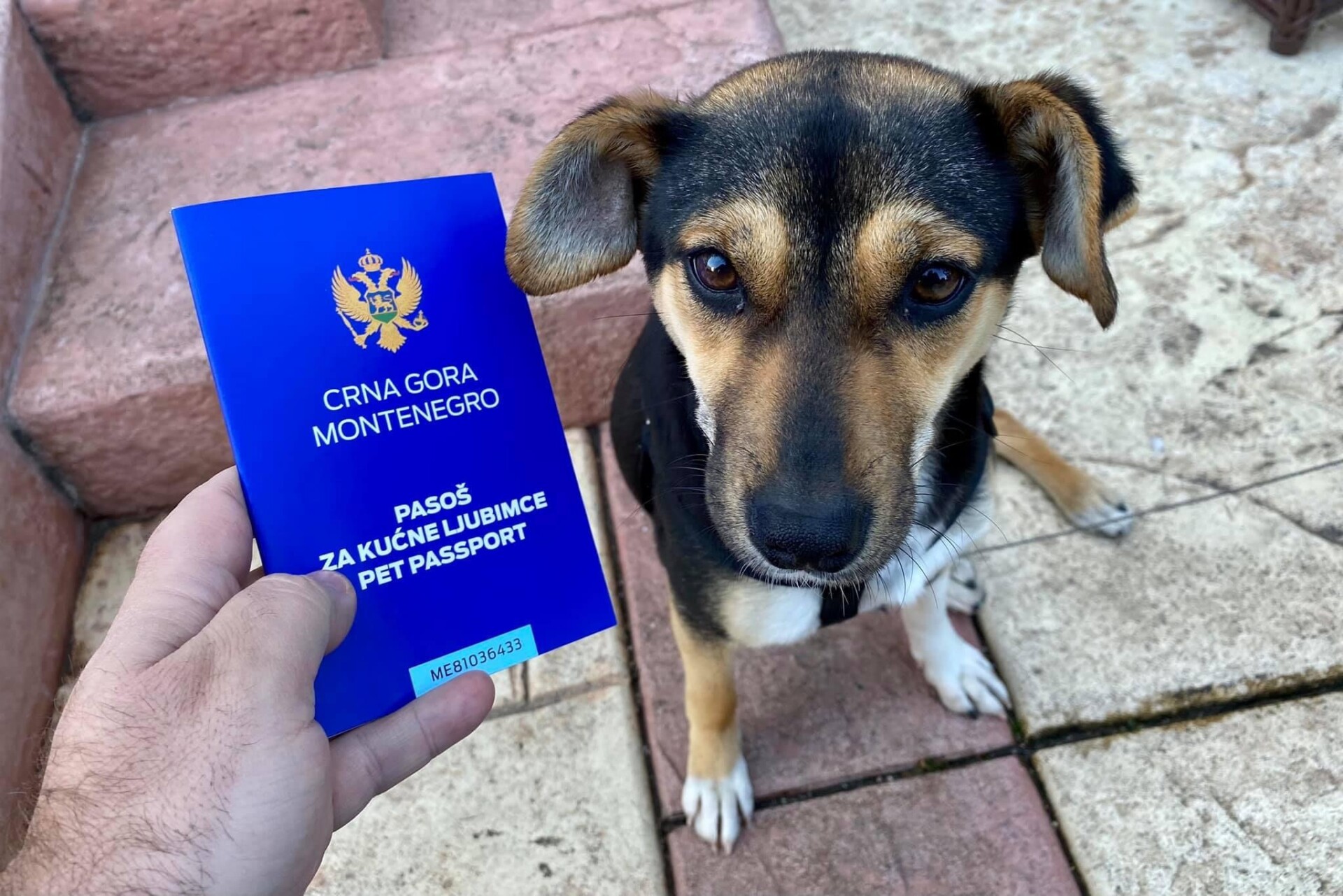
The basic requirement is an animal marked with a microchip with a blue EU pet passport and a valid rabies vaccination that clearly identifies you as its owner. Note that your pet can only be vaccinated against rabies at the age of 12 weeks or older. The vaccination is only considered effective 21 days after the first administration. With timely booster vaccinations, this waiting period does not apply.
The previously required rabies antibody test (rabies titer) is no longer required from June 19, 2026. This eliminates both the blood draw and the waiting time as well as the laboratory examination completely.
Instead, you only need a health certificate that confirms your pet is fit to travel. This is issued by your veterinarian and entered directly into the EU pet passport. It must not be older than 72 hours at the time of border crossing.
If you are traveling privately and your pet is registered with you in the EU pet passport, this veterinary certificate is sufficient.
Please note that as part of non-commercial transportation, you are generally allowed to bring a maximum of five dogs, cats, or ferrets. An exception applies only to animals that participate in exhibitions, competitions, or sporting events and meet the requirements applicable to them.
Special features: Bringing animals from other owners or traveling for longer periods
If you wish to bring animals from other owners to Montenegro, this no longer counts as purely private transport. In this case, you will need a health certificate issued by the competent official veterinarian when entering the country. This certificate must not be older than ten days at the time of crossing the border.
The difference between a veterinarian and an official veterinarian is important here: For a private holiday trip with your own dog or cat, your ordinary veterinarian is perfectly sufficient. He or she will include the health certificate in the EU pet passport. This certificate must not be older than 72 hours at the time of entry into Montenegro.
Only if it is legally no longer a private transport do you need to contact the competent official veterinarian. His/her health certificate is valid for up to ten days and must be presented upon entry.
In addition, you need a written authorization from the owner authorizing you to transport the animal. Furthermore, owners and the animal must be reunited no later than five days after the trip.
An official veterinary health certificate may also be of interest to you if you are planning a longer trip through Europe with your own dog and only want to enter Montenegro several days later. Since your veterinarian’s health certificate is only valid for 72 hours, it may already have expired before you reach the Montenegrin border. In this case, you have two options: Either you obtain an official veterinary health certificate before departure that is valid for up to ten days, or you find a veterinarian in an EU member state while traveling who will enter a new health certificate into the EU pet passport for you. Veterinarians near the border, such as in Dubrovnik, are familiar with this procedure and usually carry it out without complications.
Health protection for your beloved four-legged friend
Not necessary for entry, but urgently required for the health of your dog, is adequate protection against sandflies and other stinging insects. Sandflies can transmit leishmaniasis, an illness that often only manifests months or years later, unfortunately not yet curable and only difficult to treat. Other stinging insects can be carriers of heartworms.
Therefore, we advise you to treat your dog early, preferably three days before arrival, with a repellent. You can get suitable products from your vet or on the internet. Make sure that a spot-on product contains the repellent active ingredient permethrin or that a collar contains the active ingredients deltamethrin/flumethrin. Common products include Advantix from Bayer or the collars Scalibor and Seresto. Please read the package leaflet of your product carefully; especially for a spot-on product, protection against sandflies is usually only stated for 2 weeks. Collars often lose their effectiveness after just three months. Often, the vet will also prescribe tablets, such as Nexgard. Please note that these only take effect and kill the parasite once the insect has already taken your pet’s blood. Unfortunately, dangerous pathogens may then already have been transmitted.
Exit from Montenegro:
The basic prerequisite – the blue EU pet passport, issued in your name, your pet marked with a microchip, and a valid rabies vaccination – has already been met. Since June 19, 2026, no rabies antibody test (rabies titer) is required, making entry and exit significantly easier.
Now you need a health certificate issued by a veterinarian of your choice in Montenegro. If you are located near Bar, we can recommend the veterinary clinic Canis, with which we have successfully completed numerous such procedures.
Afterwards, you must contact the relevant veterinary inspector. Based on the veterinary examination, he or she will issue the documents required for departure. The export certificate must not be older than 72 hours at the time of crossing the border. Only with these documents can you cross the border.
Since scheduling an appointment with the veterinary inspector for holidayers is often not entirely straightforward, we are happy to assist you if you are in the Bar region. Just contact us in advance – we will arrange the appointment and help ensure that your return home goes smoothly.
We also recommend that you have the certificate of deworming against the fox tapeworm entered into the EU pet passport for your return to the EU. This should be done between 24 and 120 hours before departure. Although this deworming is not mandatory in many cases, we have repeatedly experienced that it was required at the borders.
Note here as well: If it is not a purely private transport (you are not the owner of the animal), you will additionally need the appropriate documents from the veterinary inspector as well as a written authorization from the owner authorizing you to transport the animal.
Ideally, you will leave Montenegro with the same number of animals that you brought with you. The same applies to re-entry into the EU: within the framework of non-commercial transport, a maximum of five dogs, cats or ferrets may be carried.
Export of Montenegrin dogs and cats to the EU:
As soon as you visit Montenegro, you will realize that unfortunately there are many stray dogs and cats here. Perhaps you would like to take home a rescued, found, or injured animal. However, there are a few things you need to keep in mind.
In principle, the same exit regulations apply as described above. The previous requirement for a rabies antibody test (rabies titer) is no longer required as of June 19, 2026. This has made it significantly easier to bring a Montenegrin dog or cat into the European Union.
However, a microchip remains a prerequisite, as does a valid rabies vaccination and the legal waiting period after the first vaccination. Only after these requirements have been met may the animal be allowed to leave the country.
If the animal is not yet twelve weeks old at the time of the first vaccination, the minimum age must first be reached before the vaccination can be carried out. After that, the prescribed waiting period also applies.

As you can see, bringing a Montenegrin animal into your home still requires some organization. If you would like to adopt an animal from here, please feel free to contact us. We have connections to private organizations that care for stray dogs and cats. In some cases, temporary housing is also possible until you can pick up your pet. Additionally, we can connect you with animal shelters or private animal rescuers who already have animals with all the necessary documentation.
Another important point is that rabies vaccination carried out in Montenegro is officially only valid for one year. Therefore, if you have your pet vaccinated in Montenegro or have a Montenegrin pet with a Montenegrin vaccination in Germany, you should definitely make sure to have the booster vaccination carried out in time after one year.
Which border crossings are allowed?
Entering and exiting the country with a dog, cat, or ferret is only possible through approved border crossings. Not every border crossing meets the requirements for entering and exiting the country with pets.
If you are traveling – like most holidayers – into or out of the European Union via Croatia, you should use the Debeli Brijeg – Karasovići border crossing, as it is approved for the processing of pets.
Smaller border crossings, such as Kobila – Vitaljina, are not suitable for this purpose and should not be used with a dog or cat. Plan your route accordingly so that there are no unnecessary delays or refusals at the border.
Dog-friendly Montenegro
We often get the question of how dog-friendly Montenegro really is. We can only describe it as „very dog-friendly“. In most restaurants, dogs are allowed to be brought in. Often, even unprompted, water is provided for the four-legged friends. There are also some restaurants that show special kindness towards animals, such as Le Petit Macaron in Bar.
In public, you rarely encounter negative criticism when you are travelling with dogs. For example, if you are planning a train trip, your four-legged friend is most welcome. You can find all the information on dog beaches here in our article “Dog beaches in Montenegro”. Only finding dog-friendly accommodation can sometimes be more difficult. Feel free to take a look at our accommodations here. We offer several dog-friendly apartments and houses. On some excursions, such as our boat trip on Lake Skadar, dogs are also welcome companions.

The locals’ attitude towards the street animals is also surprisingly positive. In most restaurants they are tolerated and not chased away; in some cases they are even fed. The street dogs that live here are mostly very friendly and not aggressive, so you usually don’t have to worry when you take your dog for a walk.
Here is a summary of everything important for you:
- Blue EU pet passport, issued in your name, with valid rabies vaccination (validity at least until re-entry into the EU) and unique identification of the animal through the marking of the dog or cat with a microchip
- Health certificate for the animal issued by your own vet no more than 72 hours before entry into Montenegro (sufficient for private individuals), entered in the designated field of the blue EU pet passport. Alternatively, an official veterinary health certificate issued by the competent official veterinarian (not to be confused with your own vet!), not older than 10 days (mandatory when transporting animals that are not your own, together with a written authorisation from the owner allowing the driver to transport the animal).
- As part of non-commercial transportation, a maximum of five dogs, cats, or ferrets per vehicle is allowed. An exception applies to animals that participate in exhibitions, competitions, or sporting events and meet the applicable requirements.
- Repellent mosquito protection as a collar or spot-on containing the active substances permethrin or deltamethrin/flumethrin
- When leaving Montenegro, in addition to the EU pet passport mentioned above: a health certificate from a veterinarian in Montenegro (e.g., Canis Veterinary Clinic in Bar), an export certificate from the competent official veterinarian not older than 72 hours – and our recommendation: the certificate of treatment against the fox tapeworm, entered in the blue EU pet passport at least 24 and at most 120 hours before entry into the EU.
Not in the mood for stress on holiday? Book our VET service so that your dog can also leave on a relaxed note:
You’ll find many more helpful and practical tips for traveling with your beloved four-legged friend in the book “Europe with a Dog”. You can order the new travel guide directly here: https://amzn.to/3YSUuTd